
Issue 251120.1: DWARF Operation to Create Runtime Overlay Composite Location Description
| Author: | Ben Woodard & Tony Tye |
|---|---|
| Champion: | Ben Woodard |
| Date submitted: | 2025-11-20 |
| Date revised: | 2026-08-26 |
| Date closed: | |
| Type: | Enhancement |
| Status: | Open |
| DWARF version: | 6 |
Comparing original with latest. [ Return to the latest version ]
## Introduction

Composite storage and pieces are powerful DWARF abstractions that
describe objects whose parts may reside in different locations.

While the terms "composite" and "piece" are often associated with the
piece operators, it is important to distinguish between the concepts
themselves and the operators used to construct them.

Currently, you can create composite storage with the
`DW_OP_composite`, `DW_OP_piece`, and `DW_OP_bit_piece` operators.
The `DW_OP_bit_piece` operator in particular has the problem that its
offset operand depends on the type of location. This behavior
offset operand depends on the kind of storage that the location
references. If it is register storage then the offset is interpreted
from the least significant bit end of the register; if it is memory
storage the offset is interpreted using the bit numbering and
direction conventions that are appropriate to the current language on
the target system; and if implicit storage it uses the least
significant bits of the value in that storage. This behavior conflicts
conflicts with the unified location storage abstraction provided by
with the unified location storage abstraction provided by the
the [locations on the
stack](https://dwarfstd.org/issues/230524.1.html) proposal. It should
[locations on the stack](https://dwarfstd.org/issues/230524.1.html)
concept which has the goal of making the behavior of all operations
agnostic to the storage kind they operate on.  It should be noted that
be noted that this is a problem with the operator itself, not with
this is a problem with the operator itself, not with composite storage
composite storage or the concept of pieces.
or the concept of pieces.
Another limitation of the piece operators is that their operands are
inline operands, and thus cannot be computed at runtime. This was
previously discussed in issue
[211206.2](https://dwarfstd.org/issues/211206.2.html) (stack piece
operators), and is also discussed further down this document. The
solution proposed in 211206.2 predates the acceptance of the locations
on the stack proposal, back when piece operators were still syntactic
separators that operated on their own expression stack, forcing
211206.2 to rely on DWARF expressions as inline bytecode operands.
After locations on the stack, it is now possible to design replacement
operators that simply pop arguments from the current, shared stack.

Yet another limitation is one of natural composition. With the piece
operators, it is not possible to start from a pre-computed location
and replace some part of it. For example when a field of a structure
or an array element is promoted to a register for a specific PC range.
or an array element is promoted to a register for a specific PC range,
The producer must instead build the composite piece by piece, which
the producer must instead build the composite piece by piece, which
results in DWARF expressions that are not as compact as they could be.

It is important to emphasize that these are not limitations of the
model of composite storage itself but of the existing operators used
to construct composite locations.

To address these limitations, this proposal defines a new operator,
overlay (with variants `DW_OP_overlay` and `DW_OP_bit_overlay`). It
produces composite locations and is designed to replace usages of the
aforementioned piece operators without the limitations while allowing
objects to be described in a more natural and composable way. The new
operator semantics align naturally with the post-"locations on the
stack" model. However, the resulting composite locations are just
normal composite locations that are completely indistinguishable from
ones created by the preexisting operators.

## Basic principle

In its basic form, the overlay operator produces a composite location
by conceptually taking a base location and overlaying a new location
on top of a range of storage from that base location, overriding the
original location with the new one for that range of storage.

As a simple example, consider the location of a variable of a struct
type with three 32-bit fields, whose default location is in memory
at address X:

              +-----------------------------------------+
    memory:   |        |   a   |   b   |   c   |        |
              +-----------------------------------------+
              |0       |X                               |end-of-memory


If the compiler chooses to promote field `b` to `reg1` for some
section of code, we would describe this as an overlay on top of the
memory location, of 4 bytes starting at offset 4 - relative to X -
of the `reg1` location.

                               +-------+
    reg1:                      |   b   |
              +-----------------------------------------+
    memory:   |        |   a   |///////|   c   |        |
              +-----------------------------------------+
              |0       |X                               |end-of-memory

Resulting in the following composite location with three pieces:

              +-----------------------------------------+
              | memory ...     | reg1  | memory ...     |
              +-----------------------------------------+
              |0       |X                               |end-of-composite

Note that the offset of the composite location is the same (X) as the
offset of the base memory location. The composite location still
points at the beginning of the object. The size of the composite
storage is also the same - in this particular case - as the size of
the base storage.

## Concatenation

In addition to simple overlaying as above, the overlay operators can also be
used for concatenation, by allowing a piece to be overlaid to the right of the
base location, beyond base's end. In these cases, the resulting composite
location's storage is larger than the base location's storage. This gives it
the power to replace `DW_OP_piece` and `DW_OP_bit_piece`.

For example, consider the location of a variable of a 64-bit integer
type, that has been split into a 32-bit register pair. We would
describe this as the second 32-bit register overlaying on the right of
the first register:

             +--------+
             |   h2   |     (reg2)
    +-----------------+
    |   h1   |              (reg1)
    +--------+
     +0       +4       +8

This results in the following composite:

    +--------+--------+
    |  reg1  |  reg2  |
    +--------+--------+
     +0       +4       +8

As a further extension to concatenation, the operator allows
overlaying beyond the extent of the base storage. When an overlay is
placed beyond the extent of the base storage, the gap is "filled" with
undefined storage, much like `DW_OP_piece` does when the piece is
empty. For example, consider the location of a variable of the same
struct type with three 32-bit fields, mentioned earlier. If the
compiler chooses to promote fields a and c to registers, and optimize
out field b, we may describe this with concatenation with a gap, like
so:

                      +--------+
                      |   c    |     (reg2)
    +--------+        +--------+
    |   a    |                       (reg1)
    +--------+
     +0       +4       +8

This results in the following composite:

    +--------+--------+--------+
    |  reg1  | undef  |  reg2  |
    +--------+--------+--------+
     +0       +4       +8

The following section describes in detail the use cases that motivated
the overlay operator and illustrates additional ways it can be
applied.

## Use cases

### SIMD Vectorization

It is common in SIMD vectorization for the compiler to generate code
that promotes portions of an array into vector registers. For example,
if the hardware has vector registers with 8 elements, and 8-wide SIMD
instructions, the compiler may vectorize a loop so that it executes 8
iterations concurrently for each vectorized loop iteration.

On the first iteration of the generated vectorized loop, iterations 0
to 7 of the source language loop will be executed using SIMD
instructions. Then on the next iteration of the generated vectorized
loop, iterations 8 to 15 will be executed, and so on.

If the source language loop accesses an array element based on the
loop iteration index, the compiler may read the element into a
register for the duration of that iteration. Then on the next
iteration it will read the next element into the register, and so
on. However with SIMD, this generalizes to the compiler reading array
elements 0 to 7 into a vector register on the first vectorized loop
iteration, then array elements 8 to 15 on the next iteration, and so
on.

The DWARF location description for the array needs to express that all
elements are in memory, except the slice that has been promoted to the
vector register. The starting position of the slice is a runtime
value based on the iteration index modulo the vectorization size. This
cannot be expressed by `DW_OP_piece` and `DW_OP_bit_piece` which only
allow constant offsets to be expressed.

Therefore, a new pair of operators, `DW_OP_overlay` and
`DW_OP_bit_overlay`, is defined that takes two location descriptions
plus an offset and a size, and creates a composite that uses the
second location description as an overlay of the first, positioned
according to the offset and size.

Consider an array that has been partially registerized such that the
currently processed elements are held in registers, whereas the
remainder of the array remains in memory. Consider the loop in this C
function, for example:

    extern void foo() {
        uint32_t dst[LEN];
        uint32_t src[LEN];
        // ...
        for (int i = 0; i < LEN; ++i)
            dst[i] += src[i];
    }

Inside the vectorized loop body, the machine code loads
`src[i]..src[i+7]` and `dst[i]..dst[i+7]` into registers, adds them, and
stores the result back into `dst[i]..dst[i+7]`.

Considering the location of `dst` and `src` in the loop body, the
elements `dst[i]..dst[i+7]` and `src[i]..src[i+7]` would be located in
vector registers, all other elements are located in memory. Let
register `R0` contain the base address of `dst`, register `R1` contain
`i`, and vector register `R2` contain the registerized
`dst[i]..dst[i+7]` elements.

     + dst's address stored in R0
     v
     +------------------------------------------------------+
     | 0  1  2  3  4  5  6  7  8  9  A  B  C  D  E  F 10 ...|
     +------------------------------------------------------+

     R1 contains i
     R2 has copy of a portion of dst
     +------------------------+
     + 0  1  2  3  4  5  6  7 |
     +------------------------+

We can describe the location of `dst` as a memory location with a
register location overlaid at a runtime offset involving `i`:

    // 1. Memory location description of dst elements located in memory:
    DW_OP_breg0 0

    // 2. Register location description of element dst[i] is located in R2:
    DW_OP_reg2

    // 3. Offset of the register within the memory of dst:
    DW_OP_breg1 0
    DW_OP_lit4
    DW_OP_mul

    // 4. The size of the vector register:
    DW_OP_const1u 32

    // 5. Make a composite location description for dst that is the memory #1
    //    with the register #2 positioned as an overlay at offset #3 of size #4:
    DW_OP_overlay

On the first iteration of the vectorized loop, the overlay would look like:

         +------------------------+
     R2  | 0  1  2  3  4  5  6  7 |
         +-------------------------------------------------------+
    dst  | 0  1  2  3  4  5  6  7  8  9  A  B  C  D  E  F 10 ... |
         +-------------------------------------------------------+

A consumer accessing `dst[8]` would reference the unsigned int `R0+8`
but when the consumer accesses `dst[2]`, it would reference the byte
located at offset 8 of register `R2`.

Then on the second iteration of the vectorized loop after `i` had been
incremented by 8:

                                 +------------------------+
     R2                          | 8  9  A  B  C  D  E  F |
         +-------------------------------------------------------+
    dst  | 0  1  2  3  4  5  6  7  8  9  A  B  C  D  E  F 10 ... |
         +-------------------------------------------------------+

The situation would be reversed. The consumer accessing `dst[8]` would
now reference the first byte of `R2`, but when accessing `dst[2]`, it
would reference the unsigned int located at `R0+2`.

It would be possible to express this if we introduced versions of the
piece operators that took piece sizes from the stack. The resulting
expressions would however be more tedious and less natural than with
overlay.  One problem with trying to express this with piece operators
is that the expression must be aware of the total size of the object,
in order to create an "end" piece that has the right size to cover
until the end of the object.

### Better factorization

The ability of the overlay operators to modify a portion of an
existing location, leaving the rest untouched, makes it more suitable
for factorization and composition than piece operators. For instance,
it is possible to write a simple DWARF expression that takes one
location as input, modifies one field using an overlay, and leaves the
other bytes untouched.  See proposal
[251017.1](https://dwarfstd.org/issues/251017.1.html) ("Incremental
Location Lists Using Overlays") for an example of enhancement
leveraging this property.

### Replacing piece operators

An overlay can also be used to create a composite location without
using `DW_OP_piece`. For example GPUs often store doubles in two
32b parts. An overlay can be used to combine the locations.

    DW_OP_addr 0x100
    DW_OP_addr 0x200
    DW_OP_lit4  # offset 4
    DW_OP_lit4  # size 4
    DW_OP_overlay

            +-----------------------------------------+
    overlay |                 200 201 202 203         |
    base    | 100 101 102 103                 108 ... |
            +-----------------------------------------+

([Try it!](https://intel.github.io/dwarf-evaluator/?context=%28%29&input=DW_OP_addr+0x100%0ADW_OP_addr+0x200%0ADW_OP_lit4+%3B+offset%0ADW_OP_lit4+%3B+width%0ADW_OP_overlay%0A))

A similar construct using the piece operators would be as follows:

    DW_OP_addr 0x100
    DW_OP_piece (4)
    DW_OP_addr 0x200
    DW_OP_piece (4)

([Try it!](https://intel.github.io/dwarf-evaluator/?context=%28%29&input=DW_OP_addr+0x100%0ADW_OP_piece+4%0ADW_OP_addr+0x200%0ADW_OP_piece+4%0A))

However, there is a difference. The piece operator creates a location
referencing composite storage which is 8 bytes long. It is assumed
that the value to be read are those eight bytes. With locations on the
stack, a composite piece location can be offset, but offsetting into
that location is only meaningful for those 8 bytes. Offsetting beyond
those 8 bytes is an error.

On the other hand, an overlay creates a location that extends out to
the full extent of the underlying base storage, both to the left and
to the right. Thus in this example, if the base address space is 64b
long, any offset that does not overflow the generic type would be
valid. This is not unlike memory locations, where the location storage
is always greater than the object being described. The consumer
determines how many bytes are relevant based on the type of the object.

If the producer wanted to use an overlay operator to produce exactly
what the piece operators produce (a storage with just the relevant
bytes), then it could overlay two locations over an empty composite
location.

    // Base
    DW_OP_composite

    // First half
    DW_OP_addr 0x100
    DW_OP_lit0  # offset 0
    DW_OP_lit4  # size 4
    DW_OP_overlay

    // Second half
    DW_OP_addr 0x200
    DW_OP_lit4  # offset 4
    DW_OP_lit4  # size 4
    DW_OP_overlay

                +----------------------------------+
    2nd overlay |                  200 201 202 203 |
                |+--------------------------------+|
    1st overlay || 100 101 102 103                ||
    base        || <empty composite>              ||
                |+--------------------------------+|
                +---------------------------------++

([Try it!](https://intel.github.io/dwarf-evaluator/?context=%28%29&input=DW_OP_composite%0ADW_OP_addr+0x100%0ADW_OP_lit0++%3B+offset+0%0ADW_OP_lit4++%3B+width+4%0ADW_OP_overlay%0ADW_OP_addr+0x200%0ADW_OP_lit4++%3B+offset+4%0ADW_OP_lit4++%3B+width+4%0ADW_OP_overlay%0A))

However, it is currently believed that in most cases the extra step of
making the underlying storage an empty composite is unnecessary.  The
composites produced by the piece operators and the overlay operators
should be functionally equivalent.

When a portion of the location is undefined, `DW_OP_piece` can
concatenate an empty piece of a specific size to a previous piece to
leave a section undefined.

     DW_OP_reg0
     DW_OP_piece (4)
     DW_OP_piece (4)

([Try it!](https://intel.github.io/dwarf-evaluator/?context=%28%28TargetReg+0+%22abcd%22%29%29&input=DW_OP_reg0%0ADW_OP_piece+4%0ADW_OP_piece+4%0A))

To do the same thing with overlays, the undefined portion must be
explicit. Either by using it as the underlying base storage:

    // Overlaying 4 bytes of reg0 on top of undefined location
    DW_OP_undefined
    DW_OP_reg0
    DW_OP_lit0
    DW_OP_lit4
    DW_OP_overlay

([Try it!](https://intel.github.io/dwarf-evaluator/?context=%28%0A%28TargetReg+0+%2212345678%22%29%0A%29&input=DW_OP_undefined%0ADW_OP_reg0%0ADW_OP_lit0%0ADW_OP_lit4%0ADW_OP_overlay%0A))

or by making the actual bytes undefined:

    // Overlaying 4 bytes of undefined location on top of reg0
    DW_OP_reg0
    DW_OP_undefined
    DW_OP_lit4
    DW_OP_lit4
    DW_OP_overlay

([Try it!](https://intel.github.io/dwarf-evaluator/?context=%28%0A%28TargetReg+0+%2212345678%22%29%0A%29&input=DW_OP_reg0%0ADW_OP_undefined%0ADW_OP_lit4%0ADW_OP_lit4%0ADW_OP_overlay%0A))

In the former case, the resulting composite storage has the size of
the undefined storage (i.e., the largest address space or register).
Any offset into that location beyond the first four bytes up to the
size of undefined storage is meaningful but will refer to undefined
bytes.

In the latter case, the size of the resulting composite storage depends
on the size of `reg0`. If `reg0` were 4 bytes, then the resulting
storage would be 8 bytes long, where bytes 4 up to and including 7 are
undefined. However, if the size of `reg0` were 64 bytes, then the
resulting storage would 64 bytes long, where bytes 4 up to and
including 7 are undefined.

If an overlay operation leaves a gap between the underlying base
storage and the overlay, then those bits are inferred to be undefined
and the size of the overlay grows to include the overlaid section. For
example:

    DW_OP_reg0  # assume an 8 bytes general purpose register
    DW_OP_reg1  # another 8 bytes register
    DW_OP_lit16 # well beyond the 8 bytes of reg0
    DW_OP_lit8
    DW_OP_overlay

([Try it!](https://intel.github.io/dwarf-evaluator/?context=%28%0A%28TargetReg+0+%2212345678%22%29%0A%28TargetReg+1+%22abcdefgh%22%29%0A%29&input=DW_OP_reg0++%3B+assume+a+64b+general+purpose+register%0ADW_OP_reg1++%3B+another+64b+register%0ADW_OP_lit16+%3B+well+beyond+the+8+bytes+of+reg0%0ADW_OP_lit8%0ADW_OP_overlay%0A))

This would leave the offsets between 8 (end of `reg0`) and 15
(beginning of `reg1`) undefined.

## Proposal

### Section 3.12
In Section 3.12 Composite Locations, keep the following introductory paragraphs:
Replace the introductory paragraphs in Section 3.12 Composite
Locations, with:
> A composite location represents the location of an object or value
> that does not exist in a single block of contiguous storage (e.g.,
> that does not exist in a single block of contiguous storage (for
> as the result of compiler optimization where part of the object is
> example, as the result of compiler optimization where part of the
> promoted to a register). It consists of a (possibly empty) sequence
> of pieces, where each piece maps a fixed range of bits from the
> object onto a corresponding range of bits at a new (sub-)location.
> object is promoted to a register). Its storage consists of a
> (possibly empty) sequence of <del>pieces</del><ins>parts</ins>,
> where each <del>piece</del><ins>part</ins> maps a <del>fixed</del>
> range of bits from the object onto a corresponding range of bits at
> a new (sub-)location. There are two ways to make composite storage
> overlays and pieces.
>
> The pieces of a composite location are contiguous, so that the size
> of the composite storage is the sum of the sizes of the individual
> pieces, and each piece covers a range of bits immediately following
> the previous piece. The maximum size of a block of composite storage
> is the size of the largest address space or register.

Then replace the sentence:

> Typically, the size of a composite storage is the same as that of
> the object it describes.

With:
> <ins>Overlay operators first map the entire extent of the base
> storage into composite storage. An opaque overlay is then applied,
> masking the corresponding bits of the base storage from the
> overlay's offset through its entire extent.</ins>
>
> <ins>*Typically this creates a block of storage which is the same
> size as the base storage for the overlay. The exceptions are when
> the overlay either begins or extends beyond the extent of the base
> storage. One example where this happens is when an overlay is used
> to concatenate two locations.*</ins>
>
> <ins>Instead of mapping the entire base storage into composite
> storage. The piece operators excerpt parts of storage and
> concatenate the pieces together.</ins> <del>The pieces of a block of
> composite storage are contiguous, so that
> the</del><ins>Therefore,</the> the size of the composite storage is
> the sum of the sizes of the individual pieces, and each piece covers
> a range of bits immediately following the previous piece.
>
> Typically, the size of a composite storage is at least as large as
> *Typically, the size of a composite storage <ins>created with
> pieces</ins> is the same as that of the object it describes.*
>
> <ins>The maximum size of a block of composite storage is the size of the
> largest address space.</ins> If the composite storage is smaller than the
> the object it describes.

Then after:

> If the composite storage is smaller than the object, the remaining
> bits of the object are treated as undefined.
> object, the remaining bits of the object are treated as undefined.
>
> In the process of fetching a value from a composite location, the consumer
> *In the process of fetching a value from a composite location, the
> may need to fetch and assemble bits from more than one piece.
> consumer may need to fetch and assemble bits from more than one
> piece.*
Add the following new paragraph:

> Composite locations can be formed by two methods: piece operations, which
> operate as in previous versions of DWARF, and overlay operations.
> *<ins>Another way to think of overlays rather than as an opaquie mask
> over the specified bits of base storage is to think of them as
> dividing the base storage into parts that are concatenating as if
> they were assembled with the piece operators. In most cases, this
> results in three parts: The part of the base storage before the
> overlay, the overlay itself, and the part after the extent of the
> overlayed region.</ins>*
Move the rest of the existing section into subsection 3.12.1 Piece Operations:

> 3.12.1 Piece Operations
>
> The following operation is used to form a new, empty, composite location:
>
>  ...


### Section 3.12.2 [NEW]

Add a new Section 3.12.2 after "Composite Piece Description Operations",
called "Overlay Operations".
> *Conceptually, these new composite operators create a new composite
> *Conceptually, overlay operators create a new composite location
> location which is pushed on the stack with an offset the same as the
> which is pushed on the stack with an offset remaining the same as
> base location, and composite storage that is the base location
> storage with a piece of the overlay storage spliced in, extending
> the base storage if necessary with undefined storage.*
> the base location. The resulting composite storage is the same as
> the base location storage with an opaque range of the overlay
> storage hiding the corresponding bits from the base storage.  If
> necessary, composite storage can extend beyond the extent of base
> storage. adding undefined storage when necessary to bridge a gap.*
>
> 1. `DW_OP_overlay`
>
>     `<[location] base location> <[location] overlay location> <[integral] base offset> <[unsigned] overlay width> → <[location] composite location>`
>
> 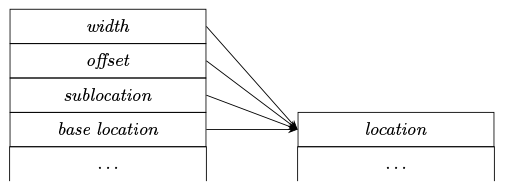 >
> `DW_OP_overlay` pushes a new composite location whose storage is the
> `DW_OP_overlay` pushes a new composite location whose storage is
>     result of replacing a slice in the storage of `base location` with
>     a slice from the storage of `overlay location`.
>     the result of replacing a selection of bytes in the storage of
>     `base location` with the specified bytes from the storage of
>     `overlay location`.
>
> The slice of bytes obtained from the storage of `overlay location`
> The selection of bytes obtained from the storage of `overlay
> is referred to as the `overlay`. The `overlay` begins at `overlay
> location` is referred to as the `overlay`. The `overlay` begins at
> location` and has a size of `overlay width`. The `overlay width`
> `overlay location` and has a size of `overlay width`. The `overlay
> cannot extend beyond the bounds of the storage of `overlay
> width` cannot extend beyond the bounds of the storage of `overlay
>     location` or else the expression is invalid.
>
> The slice of bytes replaced in the storage of `base location` is
> The selection of bytes replaced in the storage of `base location`
> referred to as the `overlay base`. It begins at `base location`
> is referred to as the `overlay base`. It begins at `base location`
>     offset by `base offset` and has a size of `overlay width`.
>
>     *If the `overlay width` is zero and offset is within the bounds of
> the base location's storage, then the consumer may leave the `base
> the base location's storage, then as an optimization consumer may
>     location` on the top of the stack rather than creating composite
>     storage.*
>     leave the `base location` on the top of the stack rather than
>     creating composite storage.*
>
>     If the `overlay base` extends beyond the bounds of the storage of
>     `base location`, the storage of the resulting location is first
>     extended by adding undefined storage sufficient to cover the
>     `overlay base`.
>
>     The offset of the resulting location is the offset of `base
>     location`.
>
>
>     The action is the same for `DW_OP_bit_overlay`, except that the
>     overlay size and overlay offset are specified in bits rather than
>     bytes.
>
> 2. `DW_OP_bit_overlay`
>
> `<[location] base location> <[location] overlay location> <[integral] base offset in bits> <[unsigned] overlay width in bits> → <[location] composite location>`
> 
>
>
> `DW_OP_bit_overlay` pushes a new composite location whose storage
> is the result of replacing a slice in the storage of `base
> is the result of replacing a selection of bits in the storage of
> location` with a slice from the storage of `overlay location`.
>     `base location` with the specified bits from the storage of `overlay
>     location`.
>
>
> The slice of bits obtained from the storage of `overlay location`
> The selection of bits obtained from the storage of `overlay location`
>     is referred to as the `overlay`. The `overlay` begins at `overlay
>     location` and has a size in bits of `overlay width`. The `overlay
>     width` cannot extend beyond the end of the overlay's storage or
>     else the expression is invalid.
>
>
> The slice of bits replaced in the storage of `base location` is
> The selection of bits replaced in the storage of `base location` is
>     referred to as the `overlay base`. It begins at `base location`
>     offset by `base offset` and has a size of `overlay width` in bits.
>
>
>     *If the `overlay width` is zero and `offset` is within the bounds
>     of the base location's storage, then the consumer may leave the
>     `base location` on the top of the stack rather than creating
>     composite storage.*
>
>
>     If the `overlay base` extends beyond the bounds of the storage of
>     `base location`, the storage of the resulting location is first
>     extended by adding undefined storage sufficient to cover the
>     `overlay base`.
>
>
>     The offset of the resulting location is the offset of `base
>     location`.

### Section 8.7.1 "DWARF Expressions"

Add the following rows to Table 8.9 "DWARF Operation Encodings":

> Table 8.9: DWARF Operation Encodings
>
> | Operation                          | Code  | Number of Operands | Notes |
> | ---------------------------------- | ----- | ------------------ | ----- |
> | `DW_OP_overlay`                    | TBA   | 0                  |       |
> | `DW_OP_bit_overlay`                | TBA   | 0                  |       |

### Appendix D.1.3 DWARF Location Description Examples

After the piece example:

>     DW_OP_composite
>     DW_OP_reg3
>     DW_OP_piece (4)
>     DW_OP_reg10
>     DW_OP_piece (2)

Replace:

>   A variable whose first four bytes reside in register 3 and whose next two
>   bytes reside in register 10.

With:

>   A variable whose first four bytes reside in register 3 and whose
>   next two bytes reside in register 10. For example as if a six byte
>   structure were passed by value using two 32 bit registers. An
>   overlay can do the same thing. On a little endian machine the
>   expression would be:
>
>     DW_OP_reg3
>     DW_OP_reg10
>     DW_OP_lit4
>     DW_OP_lit2
>     DW_OP_overlay
>
>   and on a big endian machine the expression would likely be:
>
>     DW_OP_reg3
>     DW_OP_reg10
>     DW_OP_lit2
>     DW_OP_offset
>     DW_OP_lit4
>     DW_OP_lit2
>     DW_OP_overlay

Then after the example:

>     DW_OP_composite
>     DW_OP_reg0
>     DW_OP_piece (4)
>     DW_OP_piece (4)
>     DW_OP_fbreg (-12)
>     DW_OP_piece (4)

Replace:

>   A twelve byte value whose first four bytes reside in register zero, whose
>   middle four bytes are unavailable (perhaps due to optimization), and
>   whose last four bytes are in memory, 12 bytes before the frame base.

With:

>   A twelve byte value whose first four bytes reside in register
>   zero, whose middle four bytes are unavailable, and whose last four
>   bytes are in memory, 12 bytes before the frame base.  This
>   situation most likely would occur in the case where the object
>   lives at FB-20 but the first four bytes got promoted and the next
>   four bytes got optimized away giving us the expression:
>
>     DW_OP_fbreg (-20) ; the default location
>     DW_OP_reg0        ; the promoted 32b variable
>     DW_OP_lit0
>     DW_OP_lit4
>     DW_OP_overlay
>     DW_OP_undefined   ; the variable that was optimized away
>     DW_OP_lit4
>     DW_OP_lit4
>     DW_OP_overlay
>
>   This location can be incrementally built up as optimization passes
>   act on the variable promoting some portions and optimizing out
>   others.
>
>   Assuming that reg0 is a 32b register, and the end result is known
>   a more compact way to specify the location is to create an overlay
>   on top of reg0. Because any gap between the end of the base
>   storage and the overlay is undefined, thhis leaves a hole of
>   undefined storage between the last bit of reg0 and the beginning
>   of the value in fbreg(-12).
>
>     DW_OP_reg0
>     DW_OP_fbreg (-12)
>     DW_OP_lit8
>     DW_OP_lit4
>     DW_OP_overlay

After the example below:

>     DW_OP_composite
>     DW_OP_lit1
>     DW_OP_stack_value
>     DW_OP_piece (4)
>     DW_OP_breg3 (0)
>     DW_OP_breg4 (0)
>     DW_OP_plus
>     DW_OP_stack_value
>     DW_OP_piece (4)
>
> The object value is found in an anonymous (virtual) location whose value
> consists of two parts, given in memory address order: the 4 byte value 1
> followed by the four byte value computed from the sum of the contents of
> r3 and r4

Add:

> The equivalent expression using overlays would be:
>
>     DW_OP_lit1
>     DW_OP_stack_value # while 1 can fit into a single byte stack_value
>                       # promotes it to a generic type
>     DW_OP_breg3 (0)
>     DW_OP_breg4 (0)
>     DW_OP_plus
>     DW_OP_stack_value
>     DW_OP_lit4
>     DW_OP_lit4
>     DW_OP_overlay

After:

>     DW_OP_composite
>     DW_OP_reg0
>     DW_OP_bit_piece (1, 31)
>     DW_OP_bit_piece (7, 0)
>     DW_OP_reg1
>     DW_OP_piece (1)
>
>   A variable whose first bit resides in the 31st bit of register 0,
>   whose next seven bits are undefined and whose second byte resides
>   in register 1.

Add:

> A similar expression done with bit overlays:
>
>     DW_OP_reg0
>     DW_OP_lit31
>     DW_OP_bit_offset
>     DW_OP_lit0
>     DW_OP_lit1
>     DW_OP_bit_overlay
>     DW_OP_reg1
>     DW_OP_lit8
>     DW_OP_lit8
>     DW_OP_bit_overlay
>
> While this looks considerably longer, the piece operators take
> inline operands while the overlay operators have stack operands. The
> extra stack operands take more operations, but the same number of
> bytes in most cases.

### Section D.13 Figure D.66 C implicit pointer example #1

Replace:

>     21$:   DW_TAG_variable
>            DW_AT_name("s")
>            DW_AT_type(reference to S at 1$)
>            DW_AT_location(expression=
>                 DW_OP_breg5(1) DW_OP_stack_value DW_OP_piece(2)
>                 DW_OP_breg5(2) DW_OP_stack_value DW_OP_piece(1)
>                 DW_OP_breg5(3) DW_OP_stack_value DW_OP_piece(1))

With:

>     21$:   DW_TAG_variable
>            DW_AT_name("s")
>            DW_AT_type(reference to S at 1$)
>            DW_AT_location(expression=
>                 DW_OP_breg5(1) DW_OP_stack_value
>                 DW_OP_breg5(2) DW_OP_stack_value
>                 DW_OP_lit2 DW_OP_lit1 DW_OP_overlay
>                 DW_OP_breg5(3) DW_OP_lit3 DW_OP_lit1 DW_OP_overlay)

### Section D.13 Figure D.68 C implicit pointer example #2

Replace:

>     98$: DW_LLE_start_end[<label0 in main> .. <label1 in main>)
>             DW_OP_lit1 DW_OP_stack_value DW_OP_piece(4)
>             DW_OP_lit2 DW_OP_stack_value DW_OP_piece(4)
>         DW_LLE_start_end[<label1 in main> .. <label2 in main>)
>             DW_OP_lit2 DW_OP_stack_value DW_OP_piece(4)
>             DW_OP_lit2 DW_OP_stack_value DW_OP_piece(4)
>         DW_LLE_start_end[<label2 in main> .. <label3 in main>)
>             DW_OP_lit2 DW_OP_stack_value DW_OP_piece(4)
>             DW_OP_lit3 DW_OP_stack_value DW_OP_piece(4)
>         DW_LLE_end_of_list

With:

>     98$: DW_LLE_start_end[<label0 in main> .. <label1 in main>)
>             DW_OP_lit1 DW_OP_stack_value DW_OP_lit2 DW_OP_stack_value
>             DW_OP_lit4 DW_OP_lit4 DW_OP_overlay
>         DW_LLE_start_end[<label1 in main> .. <label2 in main>)
>             DW_OP_lit2 DW_OP_stack_value DW_OP_lit2 DW_OP_stack_value
>             DW_OP_lit4 DW_OP_lit4 DW_OP_overlay
>         DW_LLE_start_end[<label2 in main> .. <label3 in main>)
>             DW_OP_lit2 DW_OP_stack_value DW_OP_lit3 DW_OP_stack_value
>             DW_OP_lit4 DW_OP_lit4 DW_OP_overlay
>         DW_LLE_end_of_list

### Section D.18 SIMD Lane Example

Replace figure "D.8? SIMD Lane Example: DWARF Encoding" with:

>     DW_TAG_subprogram
>     DW_AT_name ("vec_add")
>     DW_AT_num_lanes .vallist.0
>     DW_TAG_formal_parameter
>         DW_AT_name ("dst")
>         DW_AT_type (reference to type: pointer to int)
>         DW_AT_location .loclist.1
>     DW_TAG_formal_parameter
>         DW_AT_name ("src")
>         DW_AT_type (reference to type: pointer to int)
>         DW_AT_location .loclist.2
>     DW_TAG_formal_parameter
>         DW_AT_name ("len")
>         DW_AT_type (reference to type int)
>         DW_AT_location DW_OP_reg2
>     ...
>     DW_TAG_variable
>         DW_AT_name ("i")
>         DW_AT_type (reference to type int)
>         DW_AT_location .loclist.3
>     ...
>     $DP1: DW_TAG_dwarf_procedure # Used by src in loclist.1
>               DW_AT_location [
>                 DW_OP_breg1 (0)   # base location of the array
>                 DW_OP_regx v1     # location of the overlay
>                 DW_OP_breg3 (0)
>                 DW_OP_lit4
>                 DW_OP_mul         # the offset of the overlay in bytes
>                 DW_OP_constu (32) # sizeof(int)*num_lanes
>                 DW_OP_overlay
>                 ]
>     $DP2:  DW_TAG_dwarf_procedure # Used by dst in loclist.2
>               DW_AT_location [
>                 DW_OP_breg0 (0)
>                 DW_OP_regx v0
>                 DW_OP_breg3 (0)
>                 DW_OP_lit4
>                 DW_OP_mul
>                 DW_OP_constu (32)
>                 DW_OP_overlay
>                 ]
>     .vallist.0:
>         range [.l1, .l2)
>             DW_OP_lit8
>         end-of-list
>
>     .loclist.1:          # src
>         range [.l0, .l1)
>             DW_OP_reg1
>         range [.l1, .l2)
>             DW_OP_implicit_pointer ($DP1, 0)
>         range [.l2, .l4)
>             DW_OP_reg1
>     .loclist.2:          # dst
>         range [.l0, .l1)
>             DW_OP_reg0
>         range [.l1, .l2)
>             DW_OP_implicit_pointer ($DP2, 0)
>         range [.l2, .l4)
>             DW_OP_reg0
>     .loclist.3:          # i
>         range [.l0, .l1)
>             DW_OP_reg3
>         range [.l1, .l2)
>             DW_OP_breg3 (0)
>             DW_OP_push_lane
>             DW_OP_plus
>             DW_OP_stack_value
>         range [.l2, .l4)
>             DW_OP_reg3
>         end-of-list
---

2026-08-26: [Revised][diff1] after 8/17/26 meeting.
Rewrote intro to Section 3.12 and revised descriptions of the
overlay operations.

